After a long time, I am back to work on a project very dear to me. It is the sequel to UFHO, the Flash game I made in 2008 while working at Visual Creative Studio.
This time, with UFHO2, we are trying to build something bigger and better. While the game will retain the basic mechanics, it will be enhanced by the addition of a single player experience complete with AI, a new dynamic soundtrack, leaderboards and whatnot.
Furthermore, it will be published on Facebook, so players won't even have the need to subscribe or create a profile: they only have to add the application! And this also means more social features.
The estimated time of deployment is March 2010 (maybe.. the end of March). I am working on graphics, programming and such, while Alessandro of Visual CS will work on the marketing and promotion, and Francesco D'Andrea will compose the music and the sound effects. We will get the help of another one who will give me support with the AI.
We have setup a development blog , and prepared a teaser for the game. I am very excited to launch into this new adventure, let's hope it turns out as expected!
Wednesday 13 January 2010

Thursday 22 October 2009
Mature games on Wii
In these days a new game was released for Wii: the on-rails shooter Dead Space: Extraction. The latest news (today/yesterday) say that the game has made a really slow start in the stores around the world, selling a mere 9.000 units in the first week.
Now news sites will once again start saying that Wii hasn't got a mature audience, that Wii owners only want casual games, and developers will start worrying about creating new Wii mature games, and shy away (more than they do now).
While I can see the point of the news sites, because I didn't buy Dead Space: Extraction myself and I don't plan to, I don't think the fault of all of this resides all in the gamers and it's not also a blame for the developers. Maybe Extraction is a good game, I am sure they put a lot of effort in it. But come on... let's analyze this.
PS3 and Xbox got Dead Space, a very good game. It sold under 2 millions (at least this is what I can find) on 3 platforms, despite being a good game and a new IP. Wii gets nothing, because it's not powerful enough. Ok, honest. But then? What do Wii owners get? An watered down on-rails shooter, just to say that Wii has got its Dead Space? No, please.
Not to mention the fact that Wii already got two Resident Evil on-rails shooters, and House of the Dead: Overkill (which at least is not an on-railified version of something else), how did they come with the big idea of porting a good IP in a - obviously - cut form on the Wii, and expect good sales?
It already happened with the Resident Evil shooters (placeholders for RE 5), Call of Duty: World at War, and other notable titles which I can't remember now. What did they hope for??
By the way, the same will happen with Call of Duty 4: Modern Warfare. Already on the internet there are image comparison between the Wii version and the PS3/X360 ones. And this doesn't bode well for the game's performance in shops.
Please, developers, try honestly and don't place the blame on the customer.
Now news sites will once again start saying that Wii hasn't got a mature audience, that Wii owners only want casual games, and developers will start worrying about creating new Wii mature games, and shy away (more than they do now).
While I can see the point of the news sites, because I didn't buy Dead Space: Extraction myself and I don't plan to, I don't think the fault of all of this resides all in the gamers and it's not also a blame for the developers. Maybe Extraction is a good game, I am sure they put a lot of effort in it. But come on... let's analyze this.
PS3 and Xbox got Dead Space, a very good game. It sold under 2 millions (at least this is what I can find) on 3 platforms, despite being a good game and a new IP. Wii gets nothing, because it's not powerful enough. Ok, honest. But then? What do Wii owners get? An watered down on-rails shooter, just to say that Wii has got its Dead Space? No, please.
Not to mention the fact that Wii already got two Resident Evil on-rails shooters, and House of the Dead: Overkill (which at least is not an on-railified version of something else), how did they come with the big idea of porting a good IP in a - obviously - cut form on the Wii, and expect good sales?
It already happened with the Resident Evil shooters (placeholders for RE 5), Call of Duty: World at War, and other notable titles which I can't remember now. What did they hope for??
By the way, the same will happen with Call of Duty 4: Modern Warfare. Already on the internet there are image comparison between the Wii version and the PS3/X360 ones. And this doesn't bode well for the game's performance in shops.
Please, developers, try honestly and don't place the blame on the customer.
Wednesday 23 September 2009
Wolfenstein

Germany has a long story of bans related to games. Censorship is higher there when it comes to blood or violence, and there's a rumor that the Government is considering a ban on all action games.
Recently Raven Software has published a game called Wolfenstein, which is the sequel of the famous Wolfenstein 3D which was retired from the market in 1994 due to its nazi references. Ah, I forgot to mention this: nazi references are banned from Germany altogether.
In fact during the localization process the guys tried to remove all references to nazism, SS, Hitler and such.
But they failed: they missed some minor textures and the publisher, Activision Blizzard, made the decision to pull the game from the German market due to this small portion of 'offending' images.
Here's a confrontation of the European version vs. the German one. Just to show how many symbols they removed, and how much damage they made to the game.
It's crazy.
Tuesday 1 September 2009
Wii Internet Channel Update
Just what I was waiting for. Well, actually not, but it's important all the same.
Nintendo released today an update to the Internet Channel for Wii, with an updated Flash Player. I haven't yet tried which version it is, I guess it's 9 or 10. (edit: read below)
The incredible news is that now Wii will be overwhelmed with GOOD Flash games rivaling Wiiware offerings. Is Nintendo crazy? Waiting for an answer, I hope that the good folks at Wiicade will update their Flash APIs for the Wii to ActionScript 3.0
Moreover, the channel is now free to download and the ones who bought it will get a refund. They will download a NES game worth 500 Wii Points for free. This is really kind from Nintendo.
EDIT: The Flash Player has been updated to Flash Lite 3.1, which means it can play Flash 8 movies or lower. No AS 3.0. WHAT A SHAME.
Nintendo released today an update to the Internet Channel for Wii, with an updated Flash Player. I haven't yet tried which version it is, I guess it's 9 or 10. (edit: read below)
The incredible news is that now Wii will be overwhelmed with GOOD Flash games rivaling Wiiware offerings. Is Nintendo crazy? Waiting for an answer, I hope that the good folks at Wiicade will update their Flash APIs for the Wii to ActionScript 3.0
Moreover, the channel is now free to download and the ones who bought it will get a refund. They will download a NES game worth 500 Wii Points for free. This is really kind from Nintendo.
EDIT: The Flash Player has been updated to Flash Lite 3.1, which means it can play Flash 8 movies or lower. No AS 3.0. WHAT A SHAME.
Monday 20 July 2009
The Conduit
I just tried The Conduit for the Wii and I just can't believe how bad it is, from a graphical point of view. For months the developers bragged about the engine behind the game, and still from what I could see on the internet I wasn't convinced.
Now that I saw it first hand I see nothing but cool (?) effects, blur, bloom lights, some bump, depth of field blur and the like. But taken together they don't do a pretty picture, they are misused and pumped to the extreme just to show that they're in the game.
It's like the first movies that use 3D glasses, they are constructed so you really NOTICE that there's a 3D effect... (I'm referring to Coraline, which anyway is a good movie by itself)
For The Conduit... it just doesn't work. I didn't play it to the end, actually I just spend a few minutes with it. But the developers filled the first part with all the graphical tricks to show off, and it wasn't enough. I'm sorry but the bad art direction shines through instead. Plus, the bloom effect and blur are overused, and the bump mapping shows the different texture planes that float on each other, when seen at a close range.
This is really disappointing for them, because The Conduit's selling point was the graphics (and the controls, which work) and a bad sign for the Wii, which gets another marred exclusive.
I hope they don't fall into the same errors for their two upcoming games, The Grinder and Gladiator AD, but I think they'll just do the same.
Now that I saw it first hand I see nothing but cool (?) effects, blur, bloom lights, some bump, depth of field blur and the like. But taken together they don't do a pretty picture, they are misused and pumped to the extreme just to show that they're in the game.
It's like the first movies that use 3D glasses, they are constructed so you really NOTICE that there's a 3D effect... (I'm referring to Coraline, which anyway is a good movie by itself)
For The Conduit... it just doesn't work. I didn't play it to the end, actually I just spend a few minutes with it. But the developers filled the first part with all the graphical tricks to show off, and it wasn't enough. I'm sorry but the bad art direction shines through instead. Plus, the bloom effect and blur are overused, and the bump mapping shows the different texture planes that float on each other, when seen at a close range.
This is really disappointing for them, because The Conduit's selling point was the graphics (and the controls, which work) and a bad sign for the Wii, which gets another marred exclusive.
I hope they don't fall into the same errors for their two upcoming games, The Grinder and Gladiator AD, but I think they'll just do the same.
Thursday 2 July 2009
Mental models in games - part 2
How do we create a mental model?
Mental models are, like the word says, entities that live in our minds. They are created by observing reality and taking away only the important details, in a cycle that looks something like "Observation -> Distillation -> Application of the model -> Observation" and so on.
The observation phase is where our mind fills with all the necessary details to create the model, or at least the details that seem important. In fact the same situation can have different models based on the ultimate goal that we intend to achieve at the time of examination. Let's think, for example, of a situation in which we want to find a barber shop in an unknown urban area. The shop windows must be decoded to find one that matches our idea of a barber shop. If we were to find a big concert though, the sound cues would be a much better information compared to the visual signs, to track where the concert is.
In videogames, the ultimate goal of the game itself defines the necessary information that the player must get from the game world. This is why feedback and User Interface is so important in games: for the player to build a model of the game world, he must have all the necessary information during play. Because he only has a limited time to obtain them (he lives in the game world only for some hours) the vital informations must be presented in the best possible way, and not cluttered with unuseful bits of knowledge, unless the target of the game is to confuse the player by purpose with this information overflow (like in detective games).
Going back to PES for Wii, the designers devised a great arrows and icons sign system to provide the player with all the information she needs. For instance, each time the human player orders a shoot by shaking the nunchuck and the ball is loose, a red diamond pops on the head of the nearest player on the field. In defence, the same command orders the nearest player to clear the ball, and a blue icon pops up. Colors, iconic graphics and sounds are always the best ally when a designer is creating a model that he wants to be easy to read.
While the great deal of icons and arrows on-screen might seem an unnecessary feature, it's actually a simplified mental models that the developers provided for the player to better digest the game.
The right way
We sometimes also see games who add real-life aspects to a game. Sometimes this is done deliberately, giving frustration because the player has to keep in mind aspects which are not really related to the goal, or the ways to achieve it. Other times this is done in an efficient and effective way.
Let's take Gears of War cover system as an example. A much praised feature, it's surely a step forward that the game takes towards reality, but if we look closely to it uses the same model defined structure that we talked about at the beginning.
In the game you can't press a button to cover behind everything (like you would do in real life), instead the developers chose to clearly emphasize objects which can be used as cover. This is done by displaying an iconic graphic that is overlayed on the game world.
They mapped a button to it, to make it easy and secure: you are either under cover, or not. Besides, you don't have to turn your back to the cover or duck before. As it was not enough, when you can cover yourself behind something you see a 'cover icon' that also tells which button to press.
Going further, they also placed covers in key points, maybe just before the coming of some enemies. This gives the player the knowledge that if an enemy is coming, he surely can hide behind something (90% of the time).
This way, taking cover becomes part of the mental model of shootings in Gears of War in a very simple and effective manner: it's a very clear action, you are covered or not, the only thing to do is to press a button. Reality is here, in a distilled form.
So what?
So as always in this case there's no dos and don'ts. Adding 'unnecessary' or out-of-reality features to a game is always a perilous process, but as you can see it can actually add to a game if done the right way. Sometimes it can also lead to an entirely new conception of an aging game genre, bringing some fresh perspective to it.
The message here is to always try to distill the action that we want to put in the game, and see if it fits the mental model that a gamer could possibily build on top of the game itself. Is it ok? How can we rethink the game instead, to make space for this new action?
The game designer must always be very wary of the mental model of his game, trying to anticipate the one made by the player so both can possibly match as much as possible with each other.
Mental models are, like the word says, entities that live in our minds. They are created by observing reality and taking away only the important details, in a cycle that looks something like "Observation -> Distillation -> Application of the model -> Observation" and so on.
The observation phase is where our mind fills with all the necessary details to create the model, or at least the details that seem important. In fact the same situation can have different models based on the ultimate goal that we intend to achieve at the time of examination. Let's think, for example, of a situation in which we want to find a barber shop in an unknown urban area. The shop windows must be decoded to find one that matches our idea of a barber shop. If we were to find a big concert though, the sound cues would be a much better information compared to the visual signs, to track where the concert is.
In videogames, the ultimate goal of the game itself defines the necessary information that the player must get from the game world. This is why feedback and User Interface is so important in games: for the player to build a model of the game world, he must have all the necessary information during play. Because he only has a limited time to obtain them (he lives in the game world only for some hours) the vital informations must be presented in the best possible way, and not cluttered with unuseful bits of knowledge, unless the target of the game is to confuse the player by purpose with this information overflow (like in detective games).
Going back to PES for Wii, the designers devised a great arrows and icons sign system to provide the player with all the information she needs. For instance, each time the human player orders a shoot by shaking the nunchuck and the ball is loose, a red diamond pops on the head of the nearest player on the field. In defence, the same command orders the nearest player to clear the ball, and a blue icon pops up. Colors, iconic graphics and sounds are always the best ally when a designer is creating a model that he wants to be easy to read.
While the great deal of icons and arrows on-screen might seem an unnecessary feature, it's actually a simplified mental models that the developers provided for the player to better digest the game.
The right way
We sometimes also see games who add real-life aspects to a game. Sometimes this is done deliberately, giving frustration because the player has to keep in mind aspects which are not really related to the goal, or the ways to achieve it. Other times this is done in an efficient and effective way.
Let's take Gears of War cover system as an example. A much praised feature, it's surely a step forward that the game takes towards reality, but if we look closely to it uses the same model defined structure that we talked about at the beginning.
In the game you can't press a button to cover behind everything (like you would do in real life), instead the developers chose to clearly emphasize objects which can be used as cover. This is done by displaying an iconic graphic that is overlayed on the game world.
They mapped a button to it, to make it easy and secure: you are either under cover, or not. Besides, you don't have to turn your back to the cover or duck before. As it was not enough, when you can cover yourself behind something you see a 'cover icon' that also tells which button to press.
Going further, they also placed covers in key points, maybe just before the coming of some enemies. This gives the player the knowledge that if an enemy is coming, he surely can hide behind something (90% of the time).
This way, taking cover becomes part of the mental model of shootings in Gears of War in a very simple and effective manner: it's a very clear action, you are covered or not, the only thing to do is to press a button. Reality is here, in a distilled form.
So what?
So as always in this case there's no dos and don'ts. Adding 'unnecessary' or out-of-reality features to a game is always a perilous process, but as you can see it can actually add to a game if done the right way. Sometimes it can also lead to an entirely new conception of an aging game genre, bringing some fresh perspective to it.
The message here is to always try to distill the action that we want to put in the game, and see if it fits the mental model that a gamer could possibily build on top of the game itself. Is it ok? How can we rethink the game instead, to make space for this new action?
The game designer must always be very wary of the mental model of his game, trying to anticipate the one made by the player so both can possibly match as much as possible with each other.
Wednesday 1 July 2009
Mental models in games - part 1
I was pondering on Wii Sports and its relation to reality. I sometimes see people trying to play Wii Sports (tennis, for the most) like it was real tennis, and they marvel at the fact that they can't do all the gestures they would do on a real tennis court. This often happens when the person complaining has a real-life experience with the sport or activity involved in the videogame. Of course the number of people who complain about this is very, very low, as we all know Wii Sport is mainly accepted as capable of providing the most accurate real-life feel of the sports included in the package (except for Boxing, due to the Nunchuck's rough control).
This is maybe due to the fact that we humans tend to dissect reality in mental models created by our own brain. When we see a match of baseball, we strip down the movements of the players to the essential ones that dictate the game's outcome. We don't pay too much attention to all the body movements of the batter, we only need the swing movement.
In a recent book, game designer Jesse Schell says: "The only way our minds are able to get by all is by simplifying reality so we can make some sense of it. [...] Our brain do a tremendous amount of work to boil down the complexity of reality into simpler mental models that can be easily stored, considered, and manipulated1."
Very often games are based only on the mental model of a given activity, this is a very common approach that generated a lot of milestone titles in the history of gaming, we can think for example of the Sims or Sim City, flying simulator, and most sport games. They mirror a real life activity only in its most important aspects, they are (under the graphics) the same mental model that our brain creates when dealing with that activity. Useful data, possible actions, nothing more. This gives the brain a relief because it doesn't have to draw the model itself, so it can concentrate on the gaming, on the goals, on the ways to achieve them.
Actually, some game designers of old performed this simplifying activity only because of technical limitations. A game like Pac Man permits movement only on two perpendicular axes because the hardware running it permitted only two-dimensional input (up, down, left, right).
As hardware and consoles move on, new possibilities open and game designers take advantage of them.
That's were I trace a big divide. There's two main flow of thinking: one is the people that use the new possibilities to add complexity to the game by making it more similar to reality, and those who do so to enhance gameplay (and sometimes even purposedly waste the expanded capabilities of technology just because they don't need them!).
Mind me, no-one is wrong here. Sometimes players actually like to see more complexity just for the sake of it, just to feel more immersed in the game. This is the case for shooters, driving games, flying simulations. We see better lighting, better physics, better textures, and so on. It's ok and it's a good accomplishment which I honestly like, but it's not the only way to go, as some products showed us.
A bold move
Speaking of the other branch of game concept enhancements, I really appreciated the decisions made by Konami and the designers that worked on the Wii edition of PES 2008. They made a very bold move by actually moving away from reality with this new iteration of the series, but the game is an overall success and, moreover, it provides players with a very new angle on soccer games.
For those who had not played the game, in short, it lets the player control all his team at once by moving the players on the pitch like in an RTS, with a point-and-drag style. The different players are assigned to tasks, like 'mark this opponent man-to-man', 'guard this area', 'run to that spot' and so on. Actually in the attacking phase you can also control the bearer of the ball, shoot and pass, in the typical soccer games fashion. The passing is not handled by pressing a button and a direction, but by pressing a button and pointing to the spot where you want the ball to go to.
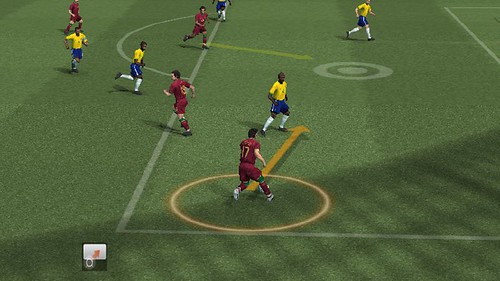
Where other games (the very same PES 2008 for the other consoles too) chose to enhance graphics, give the player more detailed and fluid animations, better commentary and so on, this Wii edition chose the unbeaten path by adding arrows on the field, icons on the head of the players about to shoot, the possibility to control both your player and the teammates, resulting in a very enjoyable, refreshing and satisfying experience.
To add all those features they took some mechanics out of the game to balance the overall complexity. They for example inhibited the possibility to direct the shoot, handing this task to the AI. Some players felt betrayed by the impossibility of controlling what were key aspects of the other editions and this, together with the apparent deep complexity of the game, cut short the game sales and success. (by the way Konami made some steps back in the 2009 edition to satisfy everyone, adding shoot directioning and the possibility to play with traditional controls)
Those willing to embrace the task though, found that the game is not so hard. Reality is that the designers, headed by Shingo 'Seabass' Takatsuka and Naoya Hatsumi spent a lot of time in finding the right way to create a new model of gaming based on mental model of soccer that gamers could find easy to decode and use. This model resembles more a soccer game as it is watched in tv than one actually played.
On the Nintendo Channel on the Wii there's a video showing the producer of the game doing experiments with eye tracking. The video clearly shows that the model works: the player doesn't have to keep an eye on the player that possesses the ball, his eye goes back and forth on the field in an effort to find an unmarked man, or free space to pass the ball. This deep testing gave the developers the assurance that the control scheme they envisioned was, if not easy, at least possible to handle for the average player.
This is maybe due to the fact that we humans tend to dissect reality in mental models created by our own brain. When we see a match of baseball, we strip down the movements of the players to the essential ones that dictate the game's outcome. We don't pay too much attention to all the body movements of the batter, we only need the swing movement.
In a recent book, game designer Jesse Schell says: "The only way our minds are able to get by all is by simplifying reality so we can make some sense of it. [...] Our brain do a tremendous amount of work to boil down the complexity of reality into simpler mental models that can be easily stored, considered, and manipulated1."
Very often games are based only on the mental model of a given activity, this is a very common approach that generated a lot of milestone titles in the history of gaming, we can think for example of the Sims or Sim City, flying simulator, and most sport games. They mirror a real life activity only in its most important aspects, they are (under the graphics) the same mental model that our brain creates when dealing with that activity. Useful data, possible actions, nothing more. This gives the brain a relief because it doesn't have to draw the model itself, so it can concentrate on the gaming, on the goals, on the ways to achieve them.
Actually, some game designers of old performed this simplifying activity only because of technical limitations. A game like Pac Man permits movement only on two perpendicular axes because the hardware running it permitted only two-dimensional input (up, down, left, right).
As hardware and consoles move on, new possibilities open and game designers take advantage of them.
That's were I trace a big divide. There's two main flow of thinking: one is the people that use the new possibilities to add complexity to the game by making it more similar to reality, and those who do so to enhance gameplay (and sometimes even purposedly waste the expanded capabilities of technology just because they don't need them!).
Mind me, no-one is wrong here. Sometimes players actually like to see more complexity just for the sake of it, just to feel more immersed in the game. This is the case for shooters, driving games, flying simulations. We see better lighting, better physics, better textures, and so on. It's ok and it's a good accomplishment which I honestly like, but it's not the only way to go, as some products showed us.
A bold move
Speaking of the other branch of game concept enhancements, I really appreciated the decisions made by Konami and the designers that worked on the Wii edition of PES 2008. They made a very bold move by actually moving away from reality with this new iteration of the series, but the game is an overall success and, moreover, it provides players with a very new angle on soccer games.
For those who had not played the game, in short, it lets the player control all his team at once by moving the players on the pitch like in an RTS, with a point-and-drag style. The different players are assigned to tasks, like 'mark this opponent man-to-man', 'guard this area', 'run to that spot' and so on. Actually in the attacking phase you can also control the bearer of the ball, shoot and pass, in the typical soccer games fashion. The passing is not handled by pressing a button and a direction, but by pressing a button and pointing to the spot where you want the ball to go to.
Where other games (the very same PES 2008 for the other consoles too) chose to enhance graphics, give the player more detailed and fluid animations, better commentary and so on, this Wii edition chose the unbeaten path by adding arrows on the field, icons on the head of the players about to shoot, the possibility to control both your player and the teammates, resulting in a very enjoyable, refreshing and satisfying experience.
To add all those features they took some mechanics out of the game to balance the overall complexity. They for example inhibited the possibility to direct the shoot, handing this task to the AI. Some players felt betrayed by the impossibility of controlling what were key aspects of the other editions and this, together with the apparent deep complexity of the game, cut short the game sales and success. (by the way Konami made some steps back in the 2009 edition to satisfy everyone, adding shoot directioning and the possibility to play with traditional controls)
Those willing to embrace the task though, found that the game is not so hard. Reality is that the designers, headed by Shingo 'Seabass' Takatsuka and Naoya Hatsumi spent a lot of time in finding the right way to create a new model of gaming based on mental model of soccer that gamers could find easy to decode and use. This model resembles more a soccer game as it is watched in tv than one actually played.
On the Nintendo Channel on the Wii there's a video showing the producer of the game doing experiments with eye tracking. The video clearly shows that the model works: the player doesn't have to keep an eye on the player that possesses the ball, his eye goes back and forth on the field in an effort to find an unmarked man, or free space to pass the ball. This deep testing gave the developers the assurance that the control scheme they envisioned was, if not easy, at least possible to handle for the average player.
Subscribe to:
Posts (Atom)



 Posts
Posts

